Intro.
AI Agent · Digital Health · Stress Intervention
Role: Founding PM · US side, 0 → 1
Company: OZ Intelligence, Lolomimi (Seed-funded Gen AI Health Startup)
Timeline: Oct 2025 – Apr 2026
Location: Bellevue & Beijing
Stack: GPT-5.2, Apple Watch HRV, React Native
An AI agent that turns invisible HRV stress signals into 2-minute, real-time resets on your Apple Watch.
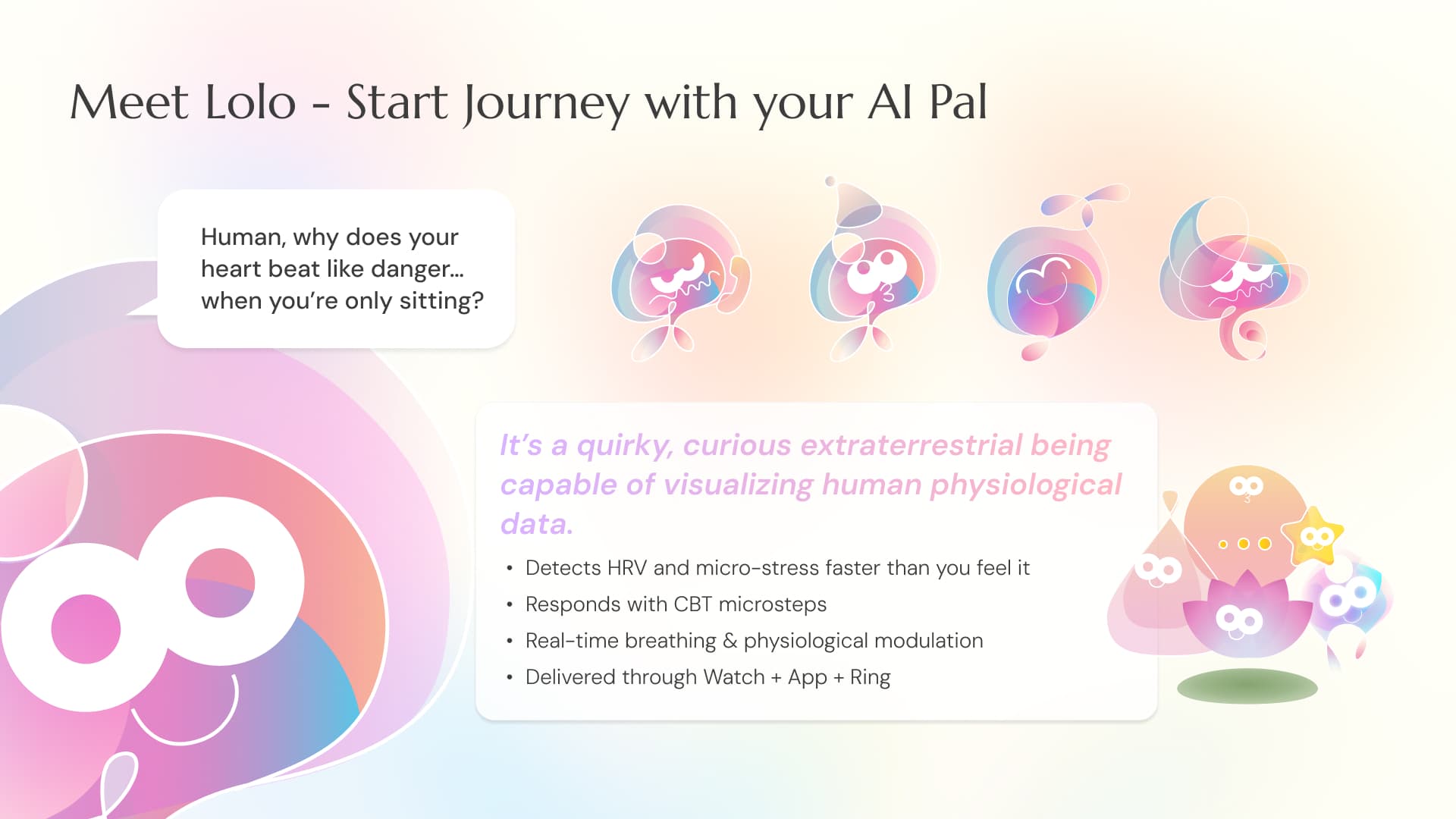
Built Lolo as an [Empathetic Alien Observer], a [quirky cosmic co-pilot]. Not a therapist, not a pet.
Designed the AI behavior system behind Lolo's notifications, companion prompts, and daily rhythm. Wrote prompt and JSON rule frameworks that control what gets pushed, when, and in what voice, keeping the persona consistent and the output safe across repeated use. The mindfulness scripts and quote library were AI-drafted; I edited every line.
TestFlight Stress-alert flow, daily rhythm, and practice library all functional.
What is Lolomimi.
Lolomimi is your quirky cosmic co-pilot for stress. It's an AI agent that lives on your Apple Watch, reads your stress signals in real time, and the moment they spike, hands you a 2-minute reset, right where you are.
It's not a therapist and not a tracker. It's an empathetic alien observer: it finds humans fascinating, watches your signals from the passenger seat, and steps in only when you need it.
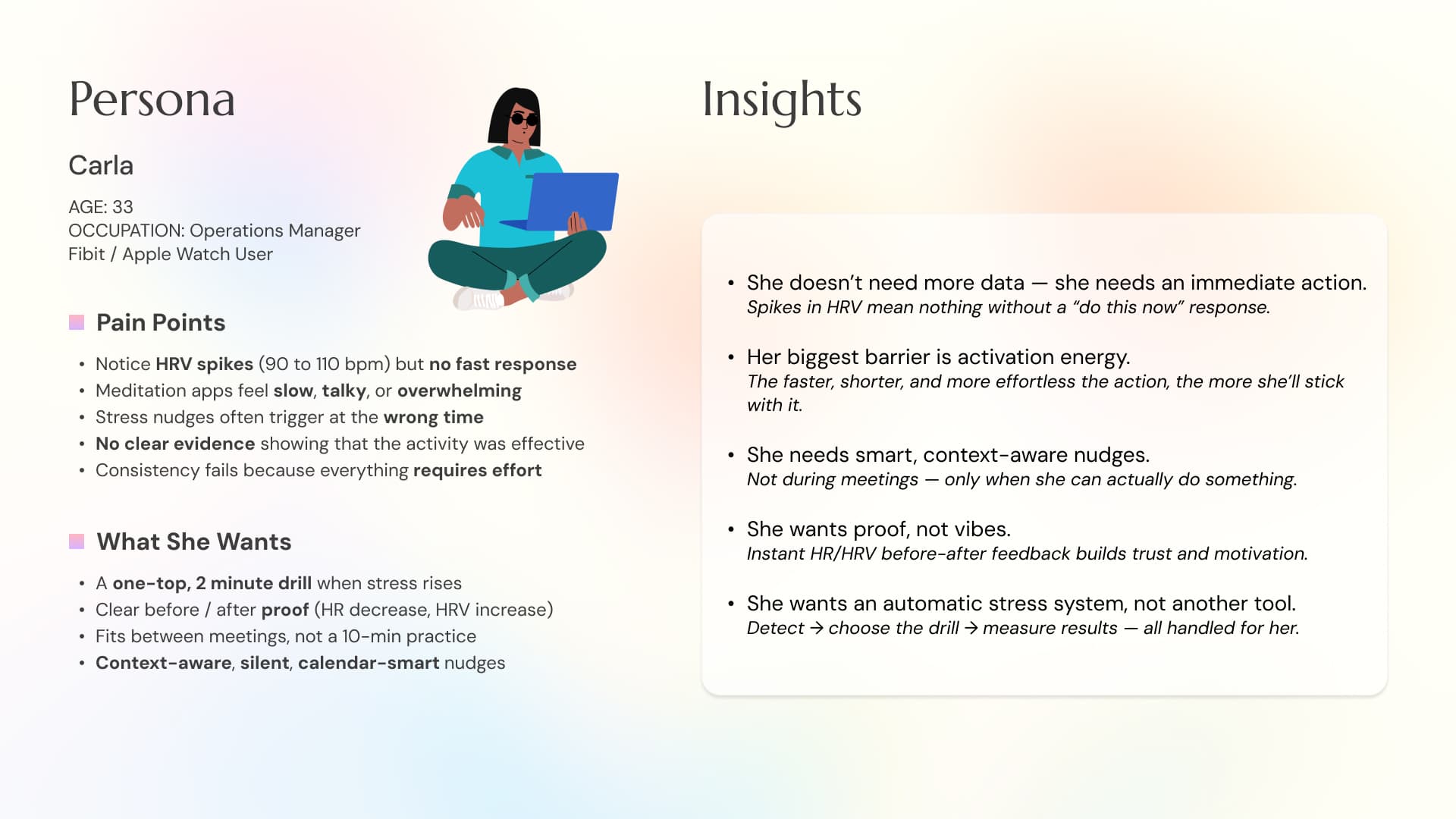
Today's wellness apps force a bad trade-off. Meditation apps ask for 20 minutes you don't have. Data dashboards tell you your stress is high, then leave you to figure out what to do about it.
One costs too much time. The other gives you numbers but no next step.
Lolomimi takes the good half of each. It catches the signal like a tracker, but instead of just showing you data, it gives you something to do in the moment. Small resets, done often, build a calm you can actually keep.
Who It's For.
How It Works.
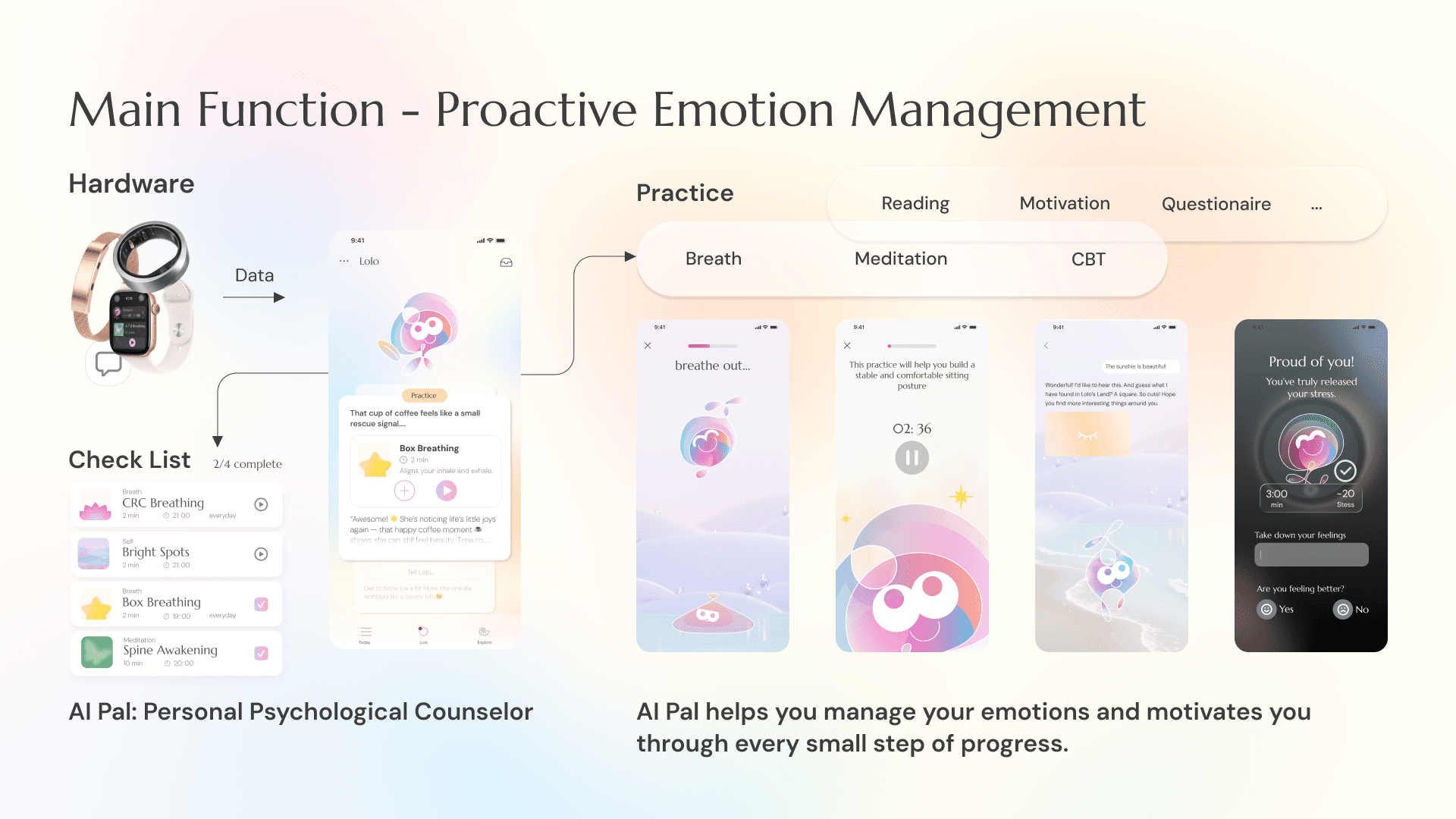
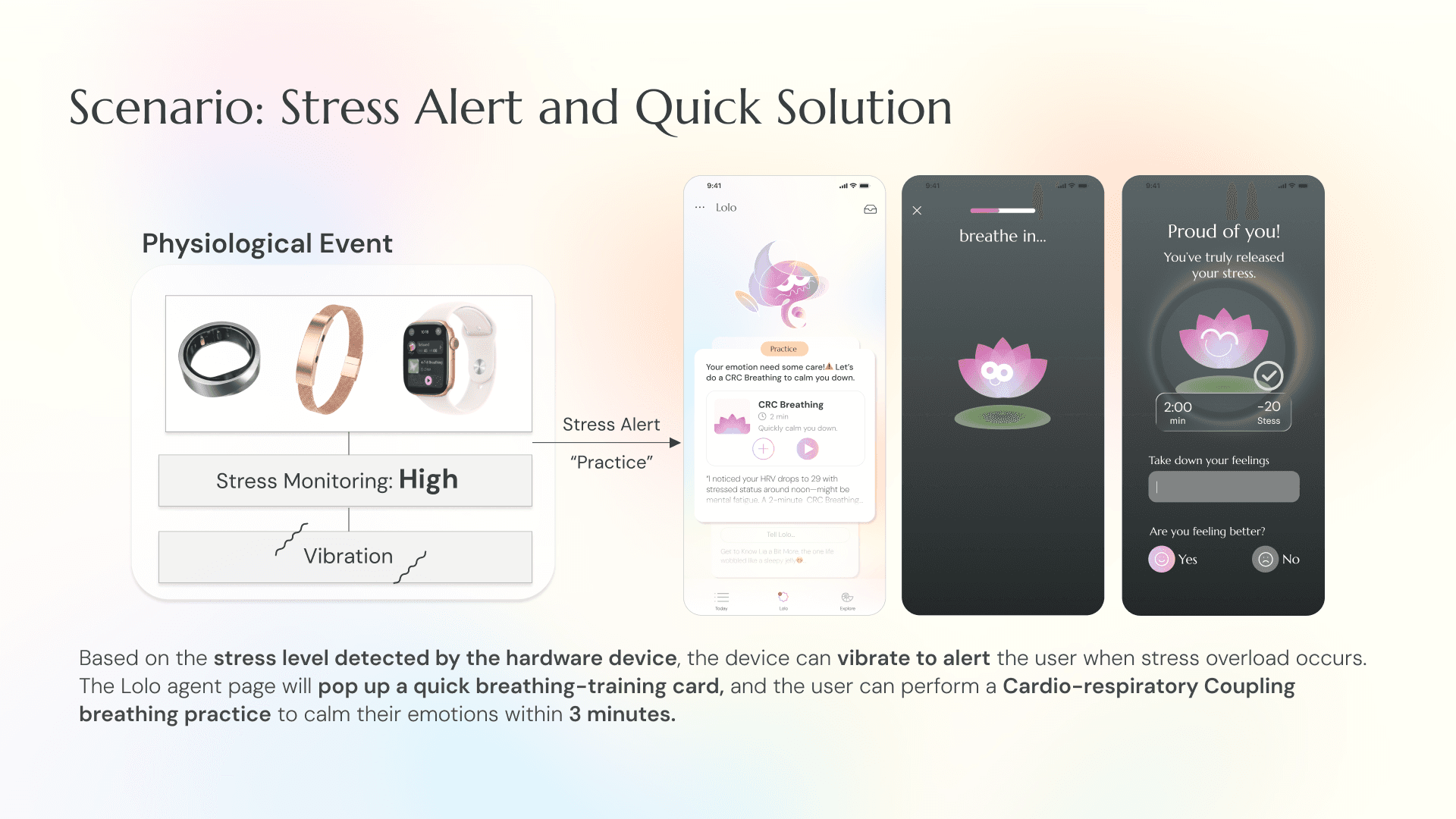
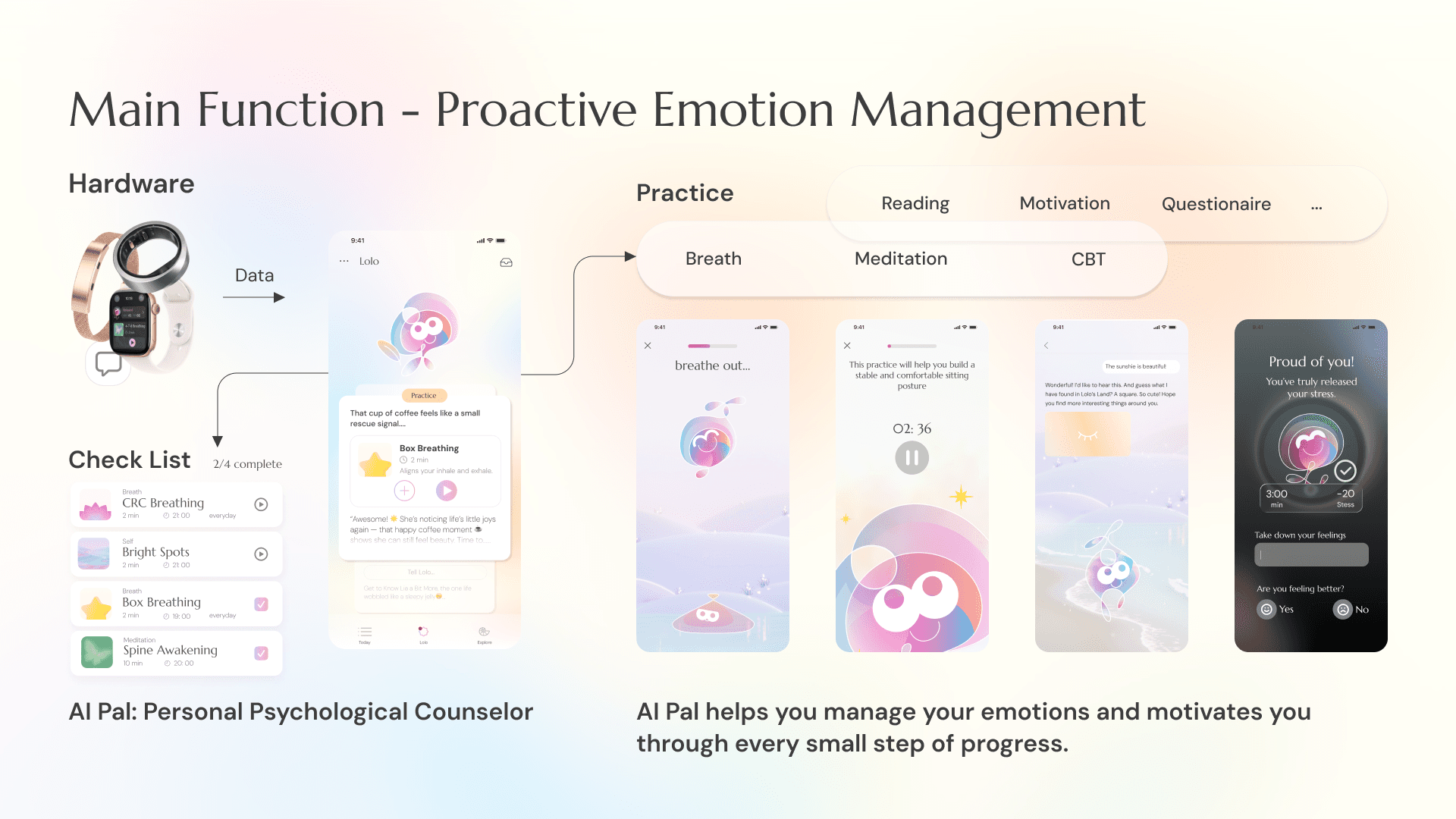
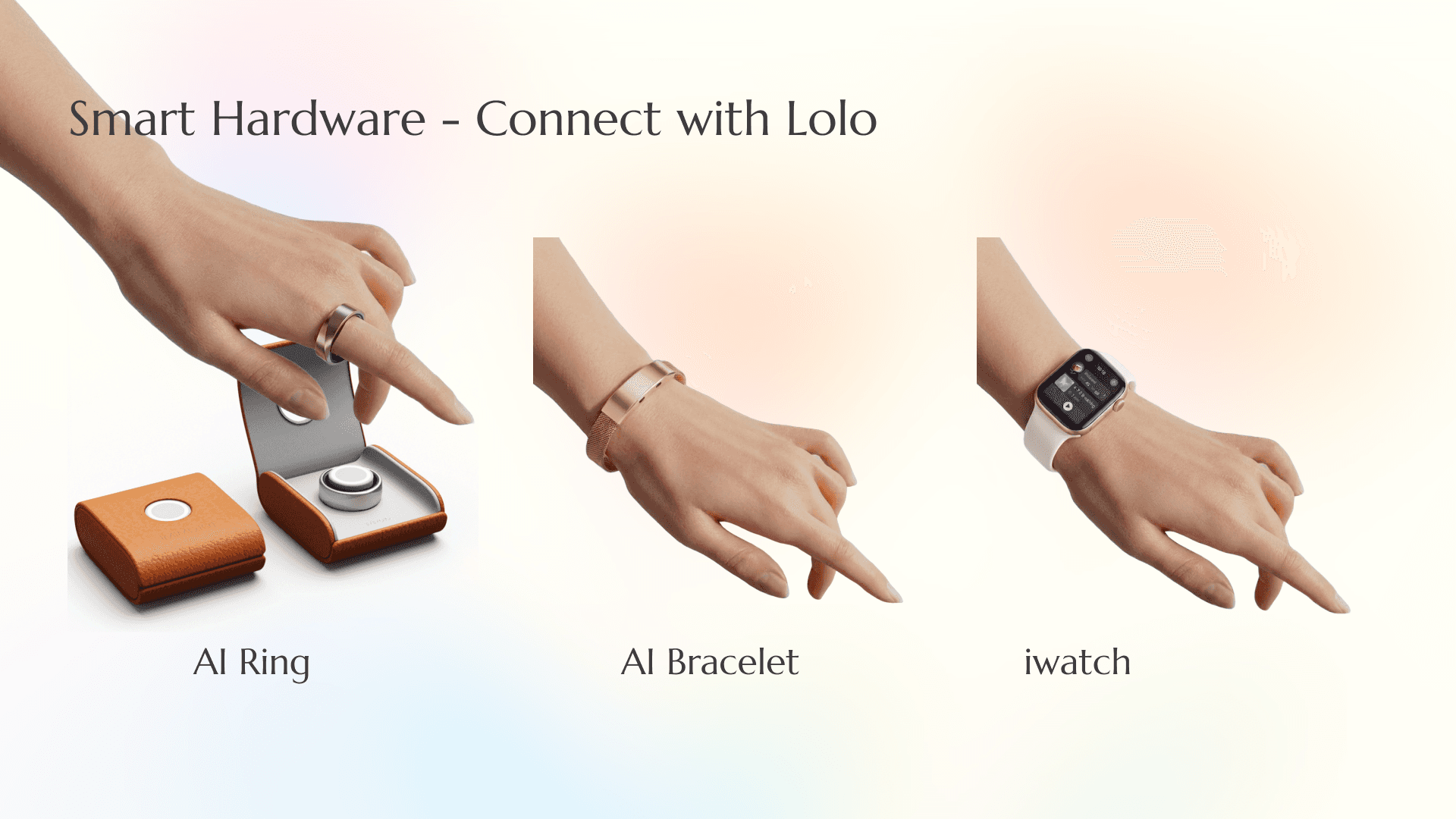
- Detect -> HRV anomaly via Apple Watch / Ring / Bracelet
- Notify -> Lightweight push, not alarmist
- Check in -> Quick status confirmation
- Intervene -> ~2-min guided breathing / CBT / meditation
- Close -> Gentle feedback, no guilt if you skip
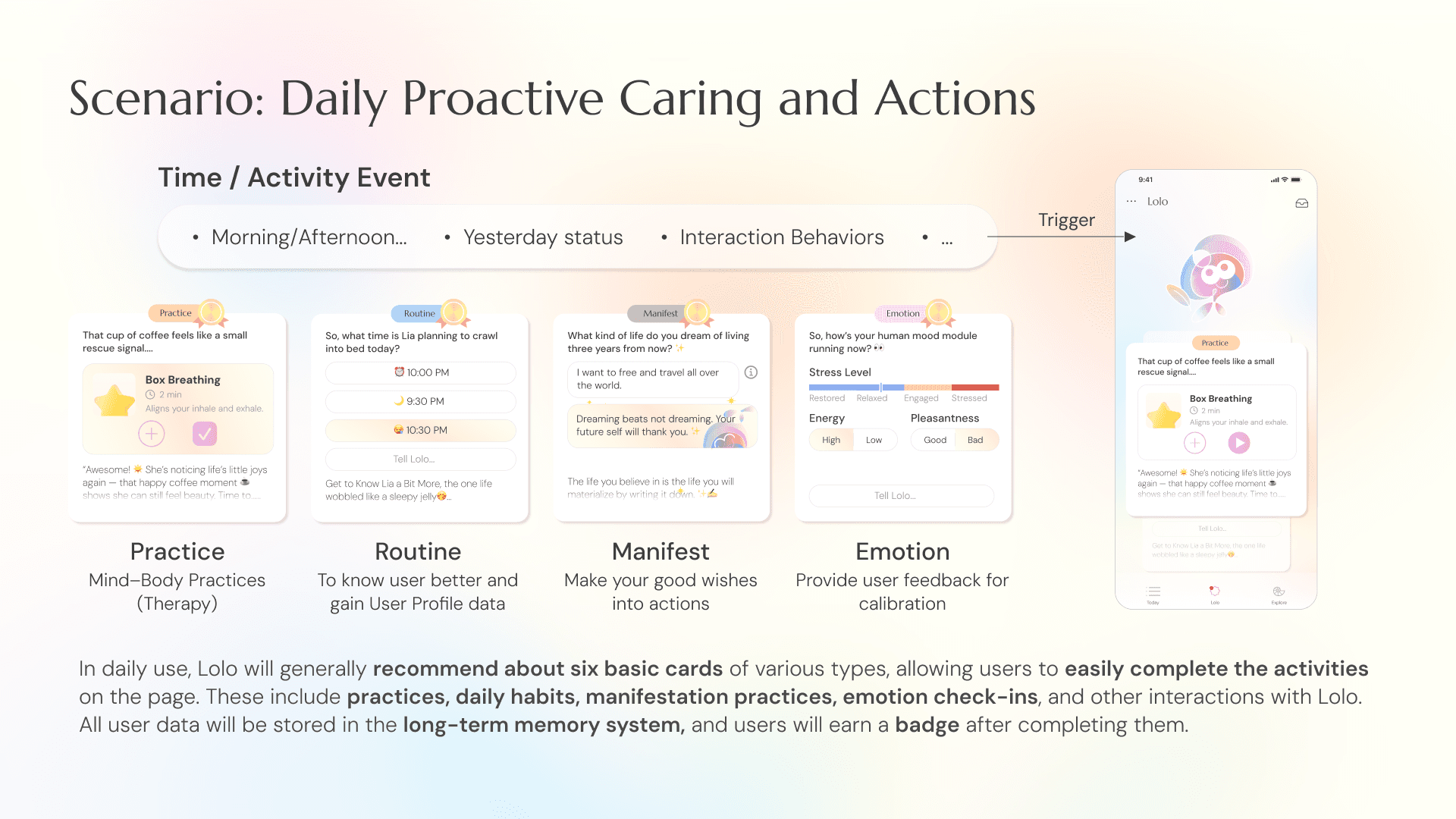
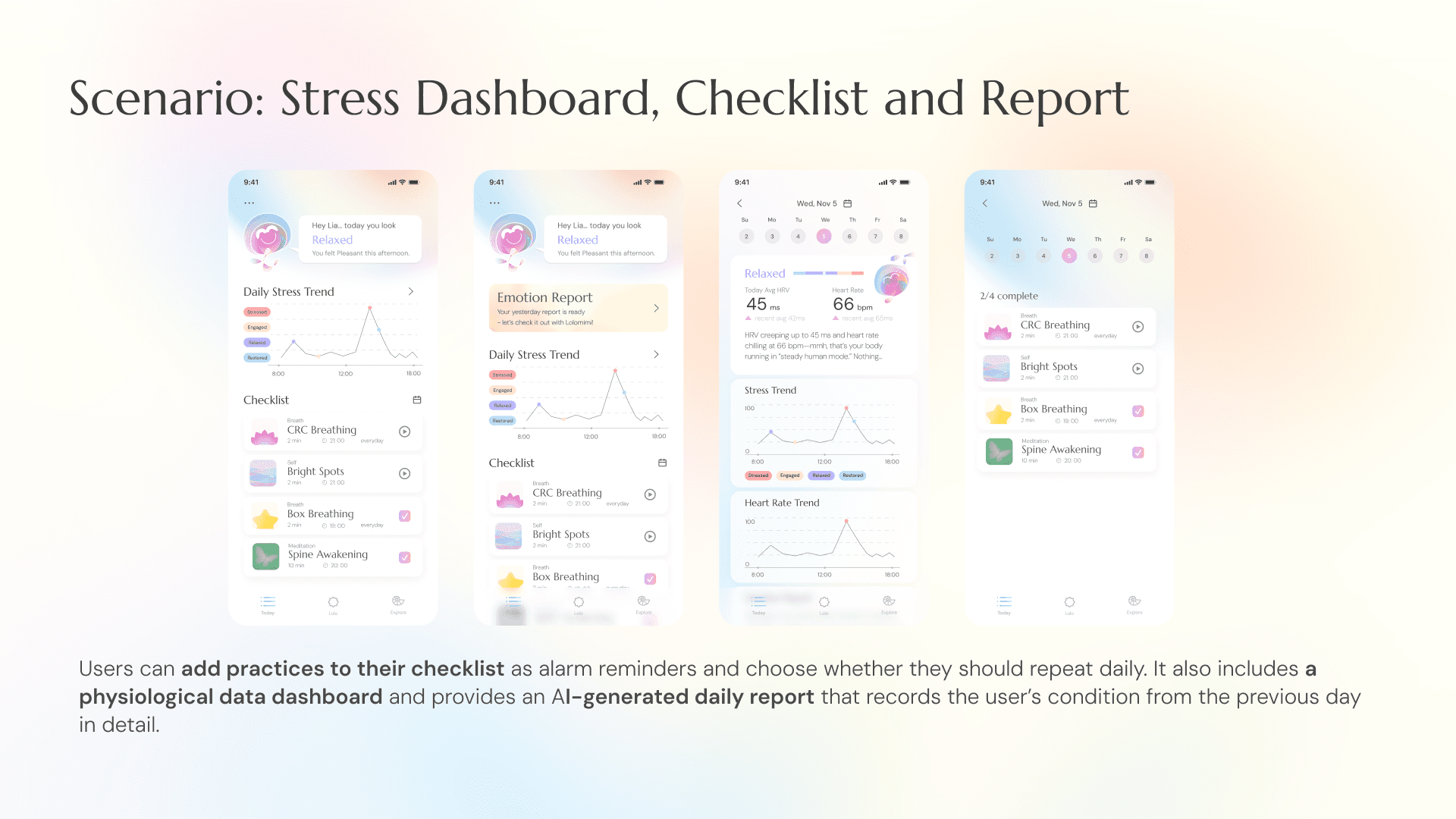
Plus a daily rhythm layer: morning and evening micro-practices. Four card types - Practice, Routine, Manifest, Emotion - each triggered by time, yesterday's status, or interaction behavior.
What I Did.
AI Interaction Design
Lolo's AI Layer
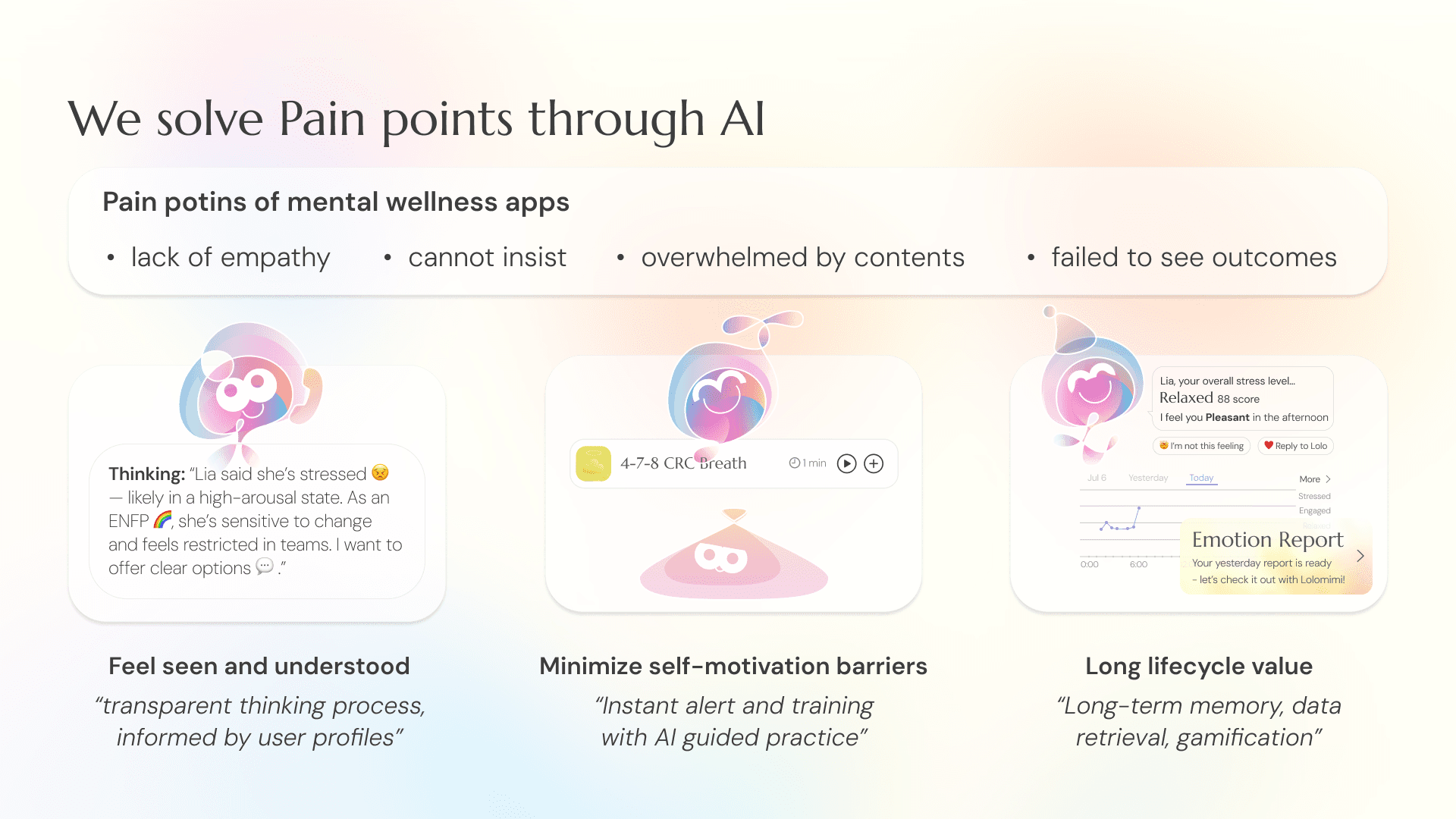
AI was used to help create the mindfulness script library, daily reflection prompts, and companion content system. All outputs were manually reviewed and edited to maintain tonal consistency and remove generic or emotionally hollow language.
[Constrained behavioral logic]Lolo was intentionally designed as a constrained interaction system rather than a free-form chatbot. Personality prompts, delivery rules, and JSON-based logic determined what content surfaced, when it appeared, and how interactions adapted to user state and context.
This constraint-based structure was important for emotional safety, consistency, and long-term trust in a repeated-use health product.
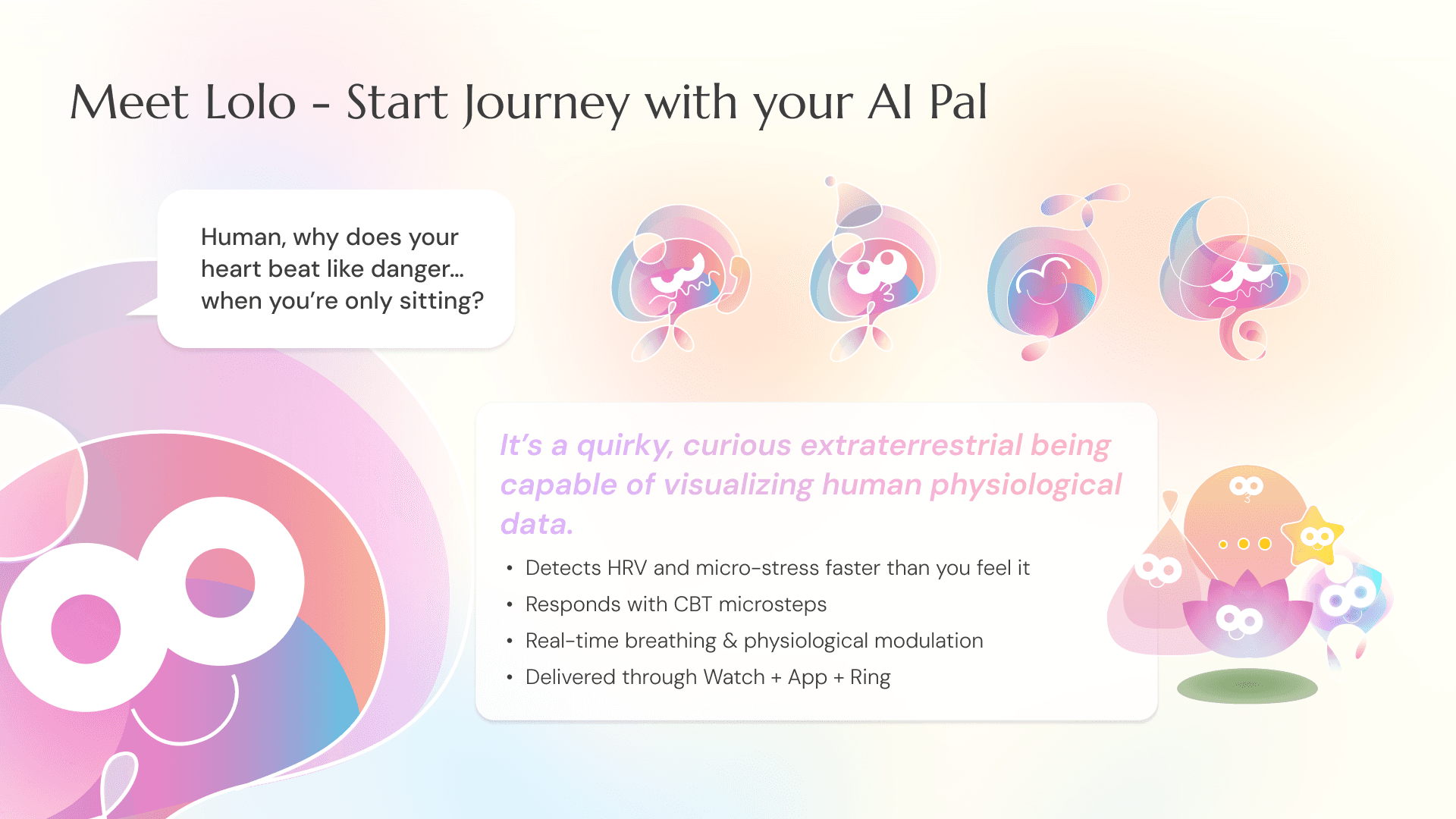
The persona: an empathetic alien observer.
Existing AI wellness products often fail in two ways: toxic positivity ("You've got this!") or overly prescriptive behavior that makes users feel managed rather than supported.
Lolo was designed as neither a therapist nor a pet, but a co-pilot — an alien observer who finds humans fascinating, emotional, and slightly absurd.
Four pillars:
- Empathetic Realism — Acknowledges difficulty without pretending everything is fine.
- Quirky & Off-beat — Uses unexpected observations and dry humor.
- Sassy but Caring — Calls out self-destructive behavior without cruelty.
- Non-Controlling — Suggests rather than directs. The user always keeps agency.
Response Structure: [Hook → Pivot → Support]
Every Lolo response followed a lightweight three-step structure embedded into the personality prompts:
- Hook — Name the stress without judgment.
"Fascinating. Your cortisol levels are higher than my spaceship's launch sequence." - Pivot — Shift from self-blame to environmental awareness.
"Earth is a noisy planet. It's not your fault your system is overheating." - Support — Offer one immediate, low-pressure action.
"Let's just breathe for 60 seconds. I'll handle the timer; you just handle the air."
Product Definition & UX
Defined the core product loop connecting physiological stress signals, lightweight interventions, and emotional feedback across mobile and Apple Watch experiences.
Led product definition, feature prioritization, interaction design, and UX flows from early wireframes to functional TestFlight prototype.
Key scenarios:
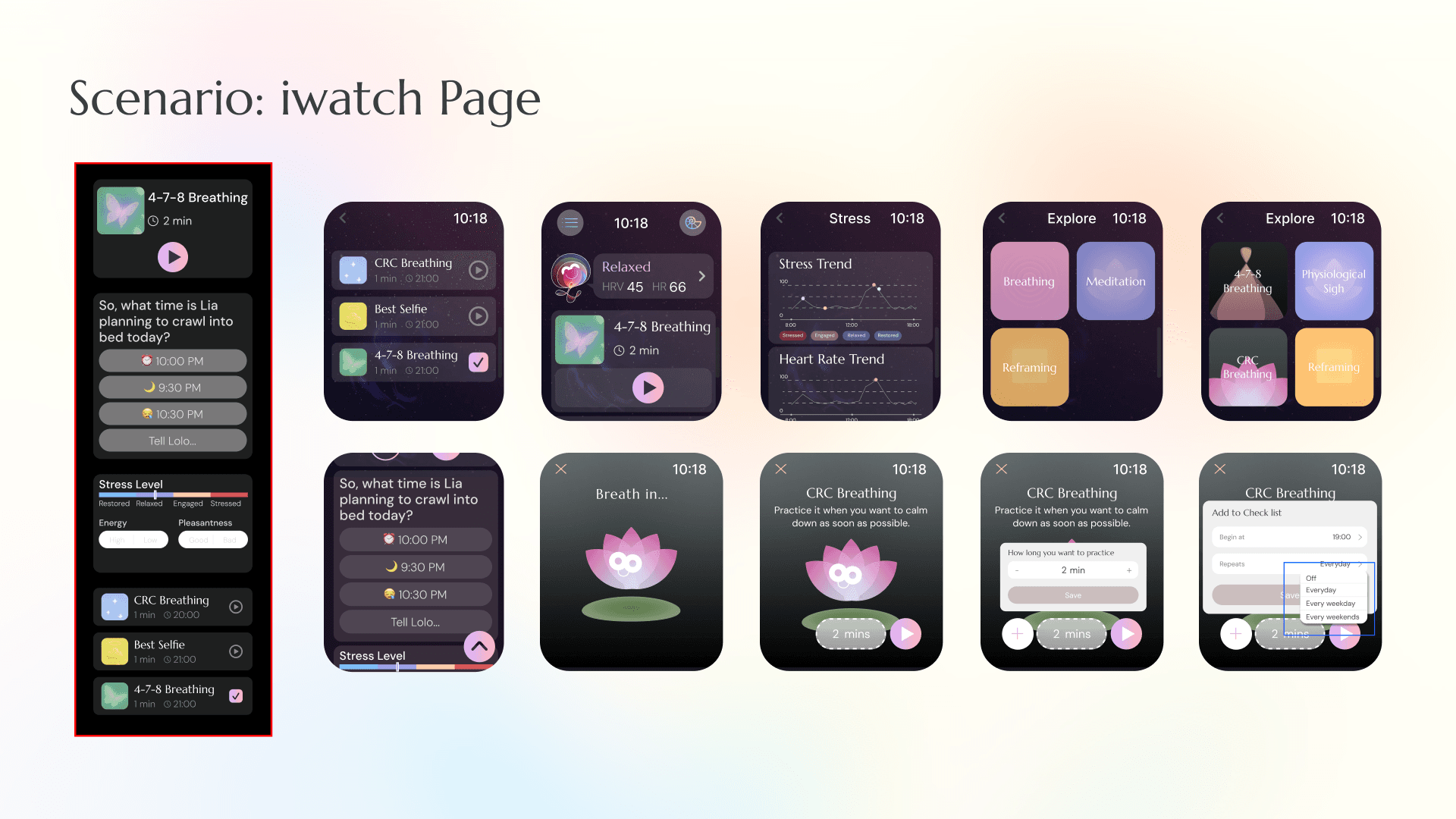
- Stress intervention loop: HRV spike → watch haptic → Lolo breathing intervention → 2-minute CRC session → emotional feedback
- Daily rhythm layer: Context-aware manifest, reflection, and practice prompts throughout the day
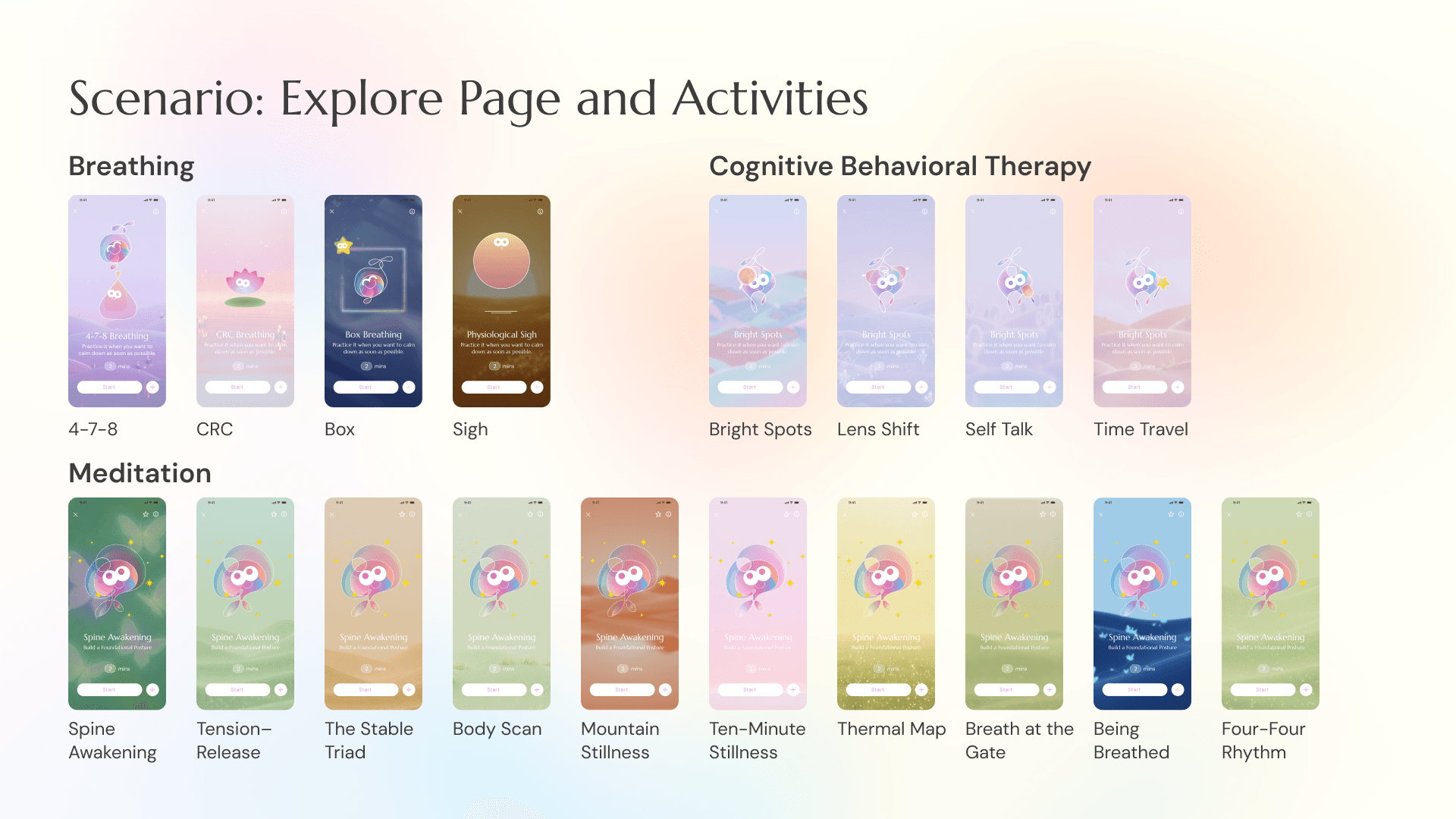
- Explore system: Guided breathing, CBT, and meditation library organized around emotional state and cognitive load
Notification System
Designed a rhythm-based notification system balancing intervention visibility with notification fatigue.
Notifications were structured by:
- Priority
- Time window
- User state
- Interruption cost
Key principles:
- HRV-triggered interventions: Only surfaced under elevated stress conditions. Messaging stayed observational rather than alarming.
- Checklist-based reminders: Anchored to user-defined routines instead of rigid schedules.
- Low-pressure language: Notifications avoided guilt, urgency, or productivity framing.
Guiding principle: notifications should increase user agency, not dependency.
Scope Decision: Cutting Gamification
Early concepts included a virtual pet progression system. The feature was intentionally removed.
Reasons:
- Behavioral conflict: The product aimed to reinforce self-awareness, not external obligation.
- Dependency risk: Reward loops risked shifting the relationship from support to maintenance.
- Focus discipline: Engineering effort was redirected toward the stress-to-intervention pipeline.
This decision helped keep the core experience lightweight, emotionally safe, and non-coercive.
LLM Selection
Evaluated GPT-5.2, Claude, and DeepSeek across tone stability, controllability, and long-term persona consistency.
GPT-5.2 was selected for the MVP due to the strongest structured output reliability and the most stable companion voice across repeated interactions.
Cross-team Coordination
Served as the US-side founding product lead, coordinating product direction, UX decisions, content systems, and implementation alignment with Beijing-based engineering and operations teams.
Worked across asynchronous time zones and evolving startup constraints while maintaining consistency across product vision, interaction behavior, and user experience.
Details.
Mind-Body Practices
The intervention library was organized around cognitive and emotional load rather than traditional wellness categories.
Three layers of support were designed for different stress states:
- Breathing — Fast physiological down-regulation through Box Breathing, 4-7-8, Physiological Sigh, and adaptive CRC breathing
- CBT Tools — Lightweight reframing exercises such as Bright Spots, Lens Shift, Self Talk, and Time Travel
- Meditation — Longer-form grounding sessions including Spine Awakening, Body Scan, and Mountain Stillness
The goal was not content quantity, but reducing friction between emotional state and action.
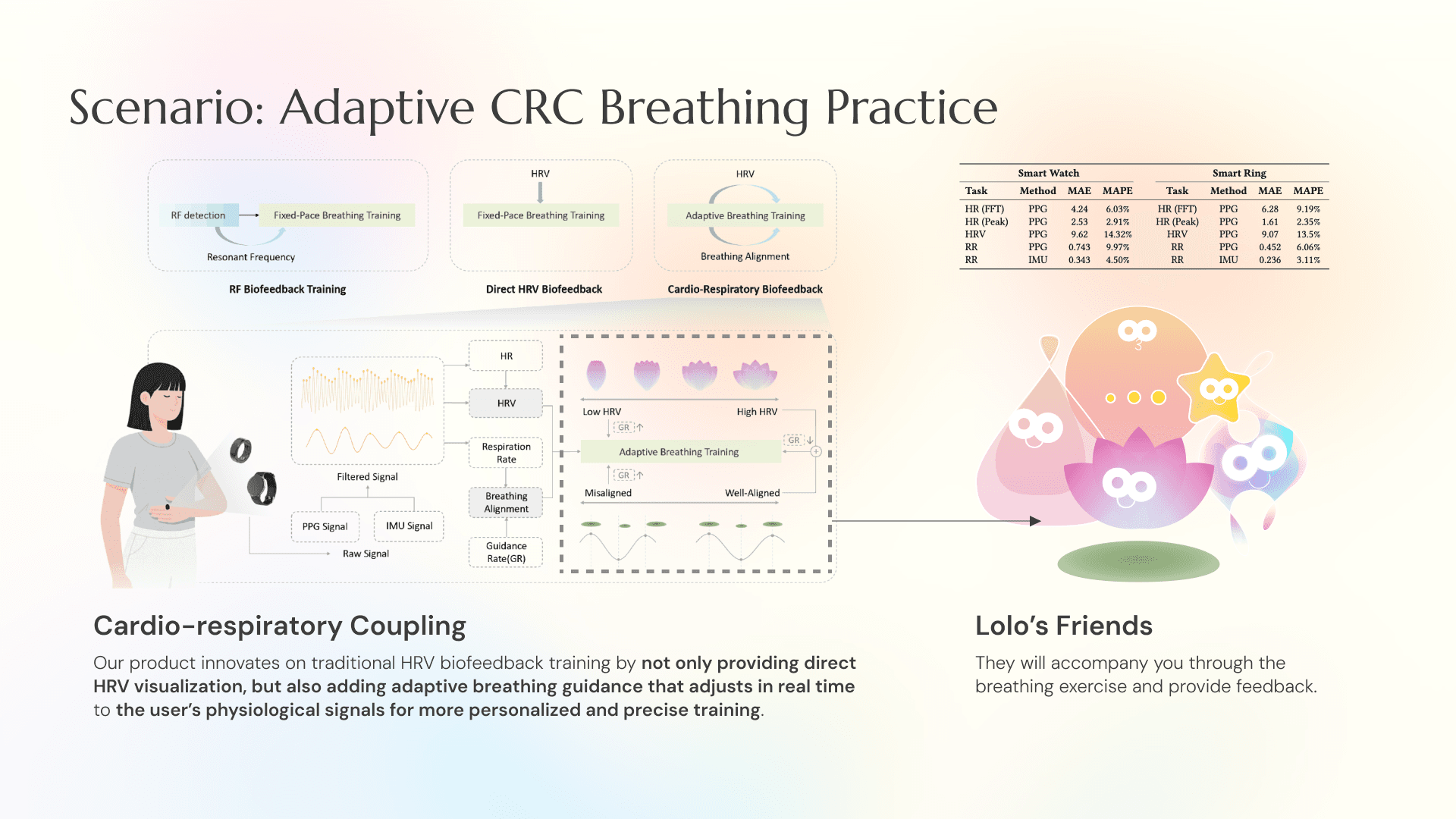
Adaptive CRC Breathing
Traditional breathing apps rely on fixed pacing patterns. Lolomimi's CRC system was designed to adapt breathing guidance in response to changing physiological signals rather than static timing loops.
The interaction model focused on:
- short intervention length (<5 min),
- low cognitive load,
- and immediate emotional accessibility during elevated stress states.
Design
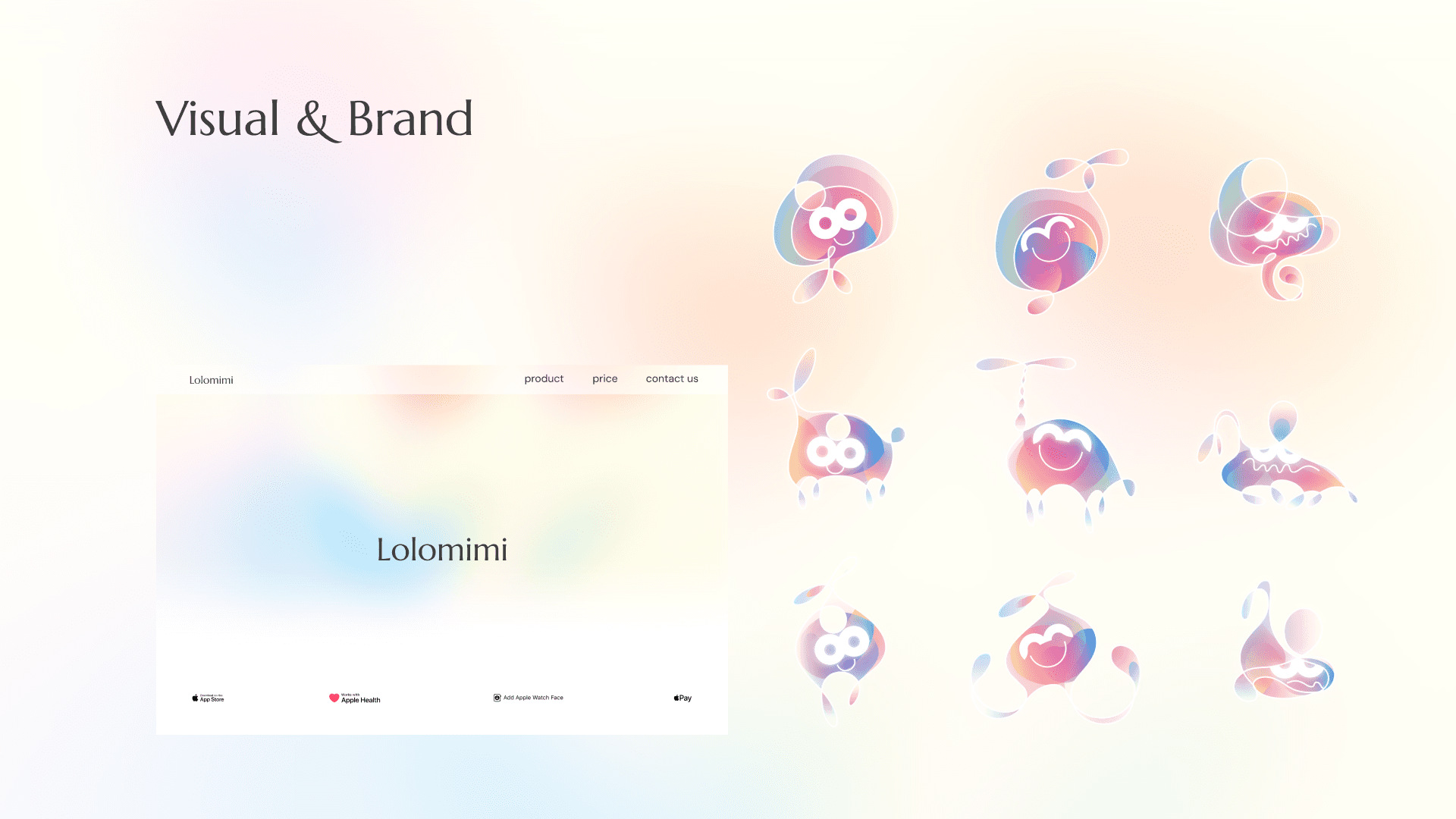
The visual system was intentionally soft, slightly surreal, and emotionally non-clinical.
Rather than using traditional wellness aesthetics or medicalized interfaces, the design language leaned toward:
- Cosmic softness
- Playful emotional distance
- Lightweight companionship
This helped reinforce Lolo's role as an empathetic observer rather than an authority figure.
Results.
Early internal testing suggested that tone and delivery style had a significant impact on whether users completed or abandoned interventions.
Live on TestFlight.
The full stress-alert flow running on device:
- HRV-triggered stress detection
- Apple Watch haptic alert
- Lolo breathing intervention
- 2-minute guided session
- Emotional feedback loop
What I Learned.
Building Lolomimi reinforced that the hardest part of digital health products is rarely the technology itself. The real challenge is designing intervention systems that feel supportive without becoming controlling, performative, or emotionally exhausting.
It also shifted how I think about AI products more broadly: in repeated-use systems, long-term trust comes less from intelligence alone and more from consistency, emotional pacing, and behavioral restraint.